A Field Guide to Conference Room Creatures
M. Eweed
11/17/20254 min read
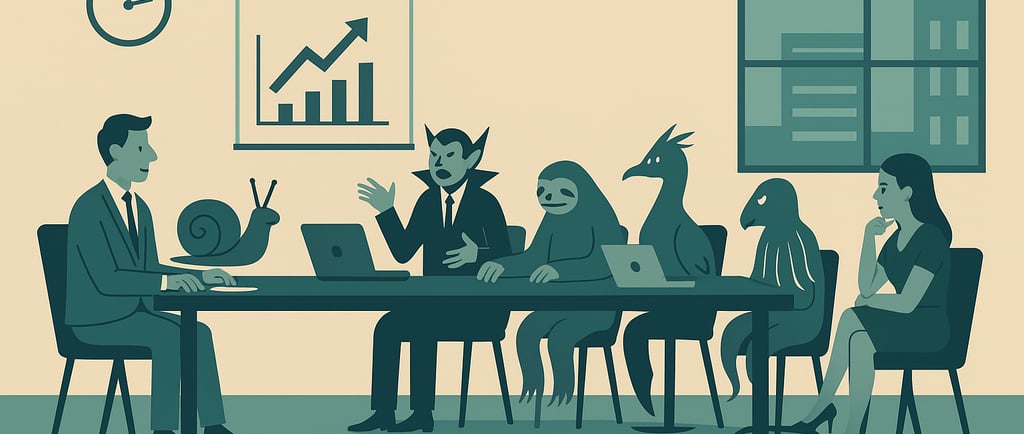
This article is from THE FISH IN THE ROOM – humans don't buy spreadsheets. And it is your unofficial “how to spot the creatures that live in conference rooms and feed on meetings'. We’re not here to judge them (much) — we’re here to understand why Slideus Maximus, the Devil’s-Advocate Vampire, and the Consensus Sloth keep thriving in captivity… and how to pet those creatures without losing your will to ship anything.
The conference room is a delicate ecosystem. Over decades of corporate evolution, certain species have adapted perfectly to this fluorescent-lit habitat. They feed on abstraction, nest in process documents, and reproduce through calendar invites. They’ve learned that in this environment, preventing motion is safer than enabling it, and looking productive beats being productive every time. You’ve seen them.
Slideus Maximus shows up with “just a quick deck” that somehow takes forty minutes. Every question gets answered with “that’s actually on slide 73.” It feeds on attention that could’ve gone to actual work, hiding behind PowerPoint because slides can’t fail—only people can.
The Devil’s-Advocate Vampire starts every sentence with “Just playing devil’s advocate here…” then murders your idea with hypothetical problems. Never proposes solutions, just questions. Feeds on other people’s courage while maintaining plausible deniability. If you fail, they warned you. If you succeed, they “pressure-tested” it.
The Consensus Sloth won’t move until “everyone’s bought in.” Schedules seventeen alignment meetings. Creates Slack polls about Slack polls. Your simple feature update now needs sign-off from legal, HR, and somehow facilities. Feeds on democracy theater while customers wait another quarter for that button to move two pixels.
The Pivot Piranha smells blood the moment anyone shows actual data. “Interesting results, but what if we tried…” And suddenly your spreadsheet becomes a machine learning project. Feeds on scope creep and the corpses of simple solutions that worked fine.
The Process Phoenix rises from the ashes of every failed project with “we need better process.” Creates forms to fill out before you can fill out forms. Your two-day task now has a fourteen-day approval chain. Feeds on bureaucracy and the tears of people who just wanted to ship something.
The Actually Dragon breathes fire on every statement. “Actually, that’s not quite right…” Lives to correct pronunciation of “Kubernetes.” Has never shipped anything but has opinions about your shipping process. Feeds on being technically correct while the customer’s still broken.
The Strong-Opinions-Loosely-Held Jellyfish has opinions that last exactly until someone senior disagrees. “I feel strongly that—oh, interesting point, I actually think the opposite now.” Feeds on spinelessness disguised as flexibility.
The Corporate Runway Model arrives ten minutes late to every meeting because she was fixing her makeup. Refuses to turn on her camera if the lighting isn’t right. Has opinions about presentation aesthetics while customers can’t access their accounts. Her impeccable outfit and salon-fresh hair discuss problems she’s never solved but looks very polished while mentioning them.
Plot Twist: They’re All Just People Reacting to the System
Here’s the thing about every creature in this field guide: they’re not the villain of your story. They’re the hero of their own.
Slideus Maximus isn’t hiding behind PowerPoint for fun. They learned that in this company, the people who make the prettiest slides don’t get blamed. They showed actual code once, live, and it crashed. The room went silent. Their boss’s eye twitched. But when they show slides? People nod. People say “great framework.” People promote them. Their brain registered: this is safer.
The Devil’s-Advocate Vampire? They proposed something bold five years ago. Got destroyed. Publicly. In front of their skip-level. Now they protect themselves by asking why other people’s ideas might fail. They get to participate without risk. On their performance review it shows up as “strong critical thinking,” but really it’s self-protection.
That Corporate Runway Model who shows up looking magazine-ready? She’s performing professionalism because she learned early that in this culture, looking put-together matters more than fixing the actual issue. She works in an aquarium where image is everything and everyone is constantly being evaluated. Her review says “executive presence.” She knows she spent more time on her appearance than on the Jira board.
The Consensus Sloth just wants everyone to feel included because they once made a decision alone and thirty people felt “blindsided.” The Process Phoenix got burned by chaos and now builds armor out of documentation. The Actually Dragon corrects others because being right about small things is the only control they have left in a job where they can’t control anything that matters.
Every one of these creatures is just a person responding to the environment they were put in. The environment that rewards talking about change over making it. The environment that promotes people who avoid visible failure rather than those who risk it. The environment that says “customer centric approach” on the walls while counting “number of decks presented” in performance reviews.
You mock them at lunch. Then you go back to your desk and open PowerPoint.
The real tragedy isn’t that these creatures exist. It’s that the aquarium is designed to create them. Every incentive, every promotion, every “great question” in a meeting that blocks progress for another week—it’s all food that trains people to swim in circles instead of forward.
Want to stop creating creatures? Change the water. Reward people who ship imperfect things over people who present perfect things. Celebrate those who made a customer’s day easier over those who made a slide deck prettier. Promote the ones who move toward problems, not away from them.
Until then, we’re all just people explaining to other people why swimming in circles makes perfect sense, while we send long emails about “alignment” after a meeting that didn’t decide anything.
Your Slideus Maximus has dreams too. They just learned to bury them under slide 73.
Contact
Your logical brain has questions. Your emotional brain wants to talk. Contanct here ..
© 2025. All rights reserved.